

About Us
At FightNewsExtra, we are passionate about delivering the latest and most comprehensive coverage of the thrilling world of combat sports. Whether you’re a hardcore fan or just discovering the excitement of boxing, MMA, and other combat disciplines, we’ve got you covered.
What We Offer
We handle All Sports News
1. Breaking News and Analysis
Stay in the loop with our real-time updates on breaking news, match results, and fighter announcements. Our team of dedicated journalists and analysts ensure you’re always ahead of the game with insightful commentary and in-depth analysis.
2. Exclusive Interviews
Get up close and personal with your favorite fighters through exclusive interviews. Gain insights into their training routines, motivations, and future plans as they share their stories with FightNewsExtra.
3. Event Coverage
Experience the intensity of major combat sports events with our detailed event coverage. From pre-fight predictions to post-fight analysis, we bring you the highlights and memorable moments that make each event unforgettable.
4. Rankings and Stats
Track the rise of fighters and stay updated on the latest rankings across various weight classes. Dive into comprehensive statistics that showcase the strengths, records, and achievements of the combat sports athletes you admire.
5. Interactive Features
Participate in polls, quizzes, and discussions with fellow fight enthusiasts. Our interactive features let you engage with the community, share opinions, and be a part of the larger conversation surrounding the world of combat sports.
6. Training and Technique
Explore the technical side of combat sports with our in-depth articles on training methodologies, fight strategies, and the science behind the sports. Whether you’re a practitioner or just curious about the intricacies, we have content tailored for you.
Join the
FightNewsExtra Community
Subscribe to our newsletter to receive regular updates directly to your inbox. Don’t miss out on the latest news, interviews, and exclusive content from the world of combat sports.
20+ Years of Experience
24/7 Availability
Thank you for choosing FightNewsExtra as your go-to source for all things combat sports. Let’s dive into the action together!
Ready to fight? Get in touch now!
Blog
-
A Boxing Training Log That Separates Rounds, Effort and Recovery

A boxing notebook becomes more useful when it records what happened rather than merely whether a session felt good. Ten rounds can describe technical shadowboxing, bag work or a very different activity involving a partner. A session lasting an hour can include long explanations, short bursts of movement or almost continuous work. Those differences disappear if every entry says only “boxing, sixty minutes.”
A practical log keeps three things separate: the session you completed, how demanding it felt and what you noticed afterward. None is a diagnosis or an automatic instruction to train harder. Together they provide a clearer record for conversations with a coach and for comparing similar sessions over time.
Describe the session before scoring it
Start with the date, session type and actual duration. Include round length when rounds are relevant, because six short rounds and six longer rounds do not describe the same amount of activity. Record whether your duration includes warm-up, explanation and rest, then use that convention consistently. Changing the definition halfway through a notebook creates an artificial change in the numbers.
Use a few stable labels such as technique, bag work, pads, conditioning and strength. A mixed session can have more than one label. Keep contact exposure and any concerning symptoms as separate notes rather than trying to convert them into a general exercise score. A low effort score cannot clear someone for contact or establish that an injury is absent.
Perceived effort belongs to the person doing the session
Perceived exertion describes the athlete’s experience of effort. It is not interchangeable with punch count, speed, heart rate or an observer’s impression. The CDC explanation of exercise intensity distinguishes relative intensity from the absolute demands of an activity: the same task can feel different to people with different capacities.
For a personal record, choose one defined scale and keep its wording visible in the notebook. Record the value at a consistent point after the session, following the approach agreed with your coach if there is one. Do not alternate between a ten-point scale and a twenty-point scale without making the change explicit. Numbers that look similar may have different meanings.
What a session-effort calculation can add
A commonly studied approach combines a session rating of perceived exertion with its duration. In Foster and colleagues’ original monitoring study, session ratings were compared with heart-rate-based scores during cycling and basketball. Relationships were consistent, but the absolute scores from the methods differed. This was not a boxing-specific validation study, and it did not turn subjective effort into a direct measure of tissue damage.
The arithmetic is easy to record: minutes multiplied by the chosen session rating. The result is usually treated as an arbitrary-unit score. Its main value in a notebook is preserving a consistent summary alongside the session description, not supplying a universal boundary between safe and unsafe training.
Two equal scores can represent different sessions
Consider this invented example. The values illustrate a calculation and are not a proposed training plan.
Fictional entries with the same calculated score Entry Duration Session rating Product Information to retain A: technical practice 60 minutes 4 240 units Footwork and controlled skill work B: conditioning 30 minutes 8 240 units Different task and effort pattern The matching products do not make the sessions physiologically identical. Multiplication deliberately compresses two inputs into one output, so different combinations can produce the same total. Keep the original inputs. A useful spreadsheet shows duration, rating and product in separate columns; it does not replace the first two with the third.
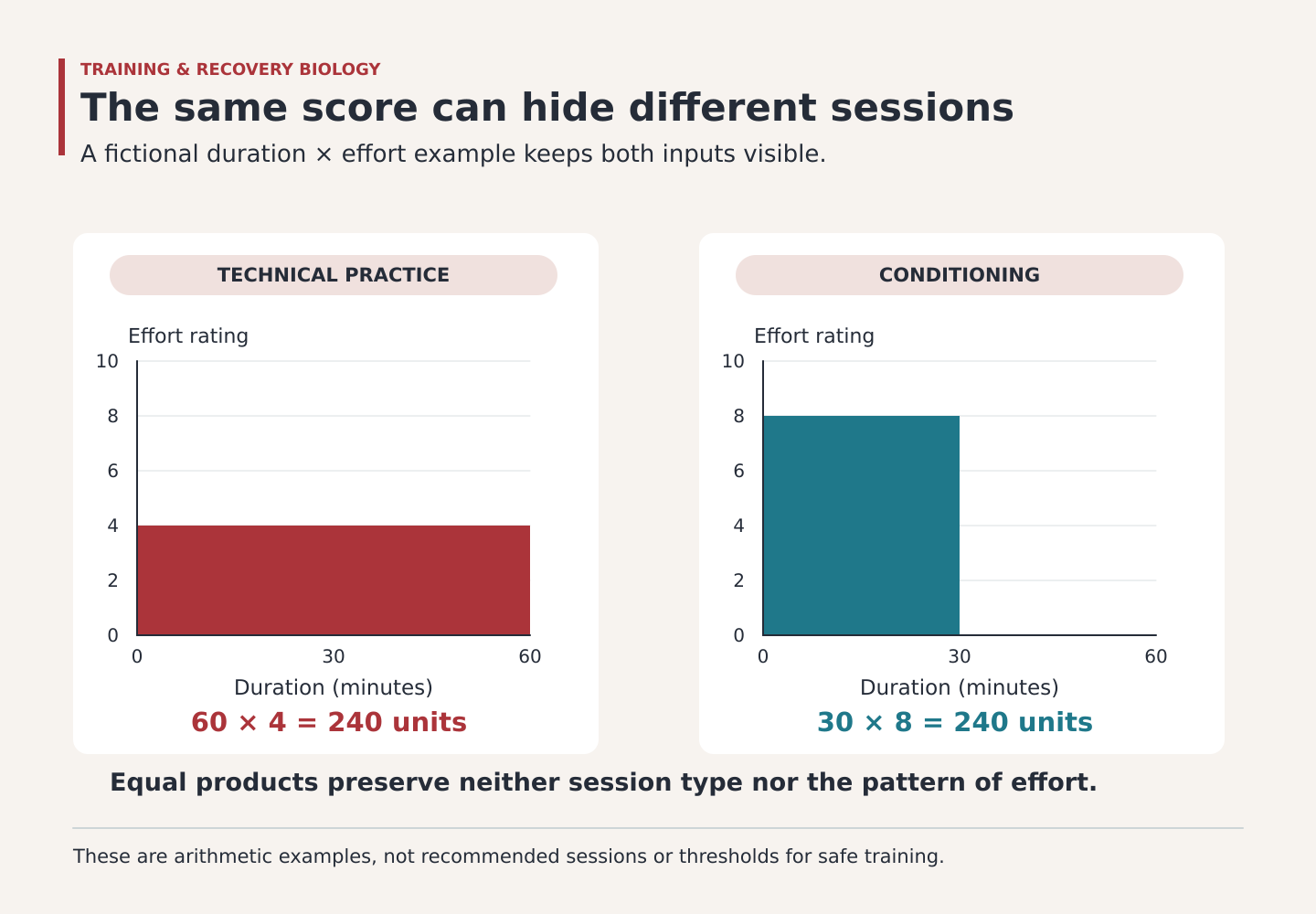
The identical products do not make the two fictional sessions physiologically identical. Image credits. Make recovery notes descriptive
A short next-day note can preserve information that would otherwise be forgotten. Use descriptions you can apply consistently: sleep opportunity, unusual travel, whether work ran late, or a new area of discomfort. Separate an observation from your explanation for it. “Woke three times” is an observation; “the new conditioning session ruined my sleep” is an interpretation requiring more evidence.
There is no need to turn every sensation into a score. One sentence may be more informative than a row of numbers whose definitions change with your mood. If you do use ratings, write down what the endpoints mean. An unexplained “recovery 6” is difficult to interpret even a week later.
Record missing information honestly
A blank effort entry is not zero effort. A missed session is different from a session you completed but forgot to record. Mark these states clearly: not performed, performed but unrecorded, or recorded with an estimated duration. Do not reconstruct a precise rating days later simply to make the spreadsheet look complete.
Similarly, a changed gym schedule should remain visible. Suppose a class becomes longer because the coach adds instruction time. Your recorded duration may increase even if active work does not. A small note about the format prevents an apparent rise in “load” from acquiring a misleading biological explanation.
Review comparable sessions together
Begin a weekly review by grouping like with like. Compare technique sessions with technique sessions, and retain different types as separate rows before calculating any overall total. Ask whether the rating changed for a similar session, whether the session itself changed, or whether the recording convention changed. These are different questions.
An unusual entry is a prompt for context, not proof of overtraining or proof that a recovery product worked. A single better score can reflect a different task, expectation, a calmer day or simple variation. The notebook becomes stronger when it preserves those possibilities instead of explaining every movement with the newest change.
Include a short version note at the top of a digital log. If you change the rating question or the definition of duration, start a new section. This simple habit keeps an apparent training trend from being a change in bookkeeping.
A compact template you can actually maintain
- Date and session type.
- Actual duration and the convention used to count it.
- Round details when they describe the work meaningfully.
- Effort rating using one defined scale.
- Optional duration-times-rating calculation.
- One sentence of context and a separate next-day observation.
Keep the form short enough to complete reliably. The useful outcome is a clear account of your training, not a perfect-looking score. A record that preserves differences between sessions helps you ask better questions about recovery without pretending that a spreadsheet can make clinical or coaching decisions on its own.
-
Secrets of Fighting: How Fighters Harness Fat Burners to Achieve Shredded Physiques for Competition

Competitive fighters are renowned for their exceptional physical conditioning and finely tuned bodies. To attain peak performance and a shredded physique, fighters often turn to various strategies, including rigorous training routines, disciplined diets, and in some cases, the strategic use of fat burners. In this blog post, we’ll explore the intriguing world of how fighters leverage fat burners to sculpt their bodies for competition.
The Basics of Fat Burners: Fat burners, also known as thermogenic supplements, are designed to enhance the body’s natural ability to burn fat. These supplements typically contain a blend of ingredients such as caffeine, green tea extract, yohimbine, and others, each with its own fat-burning properties. When used responsibly and in conjunction with a well-structured training and nutrition plan, fighters believe fat burners can provide that extra edge to achieve the desired level of leanness.

The Role of Fat Burners in a Fighter’s Regimen:
- Enhanced Energy Levels:
- One of the primary ingredients in fat burners is caffeine, a well-known stimulant. Fighters use this boost in energy to power through intense training sessions, ensuring they burn more calories and fat during their workouts.
- Appetite Suppression:
- Many fat burners contain appetite-suppressing ingredients, helping fighters adhere to strict caloric deficits. This is crucial for shedding excess body fat and achieving the low body fat percentages required for competition.
- Increased Metabolism:
- Thermogenic ingredients like green tea extract and cayenne pepper are believed to increase the body’s metabolic rate. This heightened metabolism can contribute to the accelerated breakdown of stored fat, aiding in the quest for a shredded physique.
- Targeting Stubborn Fat Areas:
- Yohimbine, another common fat burner ingredient, is thought to specifically target stubborn fat areas, such as the lower abdomen and thighs. Fighters often incorporate yohimbine into their supplement stack to address these challenging regions.
The Importance of Responsible Use: While fat burners can be valuable tools in a fighter’s arsenal, it is crucial to emphasize responsible use. Overreliance on supplements without proper attention to diet, hydration, and overall health can lead to adverse effects. Fighters should always consult with a healthcare professional before introducing any new supplements into their regimen.
Empowering Women in the Ring: Tailoring Fat Burners for Female Fighters
In the dynamic world of combat sports, women are increasingly taking center stage, showcasing their incredible skill, strength, and dedication. Just as their male counterparts, female fighters often strive for peak physical condition, which includes achieving a lean and shredded physique for competition. When it comes to the use of fat burners, it’s crucial to recognize that the needs of women may differ from men. Women’s bodies have unique hormonal profiles and metabolic considerations, and as such, choosing the right fat burners becomes paramount.
Selecting the best fat burner for women involves a thoughtful approach. While many ingredients, such as caffeine and green tea extract, can benefit both genders, certain supplements cater specifically to women’s needs. Products that include ingredients like conjugated linoleic acid (CLA) and L-carnitine are popular choices for female fighters. These compounds are believed to support fat metabolism and promote lean muscle mass, aiding women in achieving a sculpted physique without compromising muscle integrity.
As with any dietary supplement, it’s imperative for female fighters to consult with healthcare professionals or nutritionists who can guide them in selecting products that align with their individual health goals and consider any unique physiological considerations. Ultimately, the journey to a shredded physique is about empowerment, and female fighters are rewriting the narrative, demonstrating that strength, skill, and determination know no gender boundaries.
Achieving a shredded physique for competition is no easy feat, and fighters employ a combination of dedicated training, disciplined nutrition, and, in some cases, the strategic use of fat burners. It is essential to recognize that fat burners are not magic pills; rather, they are supplements that should complement a comprehensive approach to health and fitness.
As with any aspect of a fighter’s regimen, the key lies in balance and moderation. The journey to a shredded physique requires commitment, hard work, and a holistic approach that encompasses both physical and mental well-being.
- Enhanced Energy Levels:
-
The Intense World of Steroid-Enhanced Street Fighting: A Closer Look at the Highs and Lows
In the gritty world of street fighting, where raw power and aggression often reign supreme, some individuals turn to steroids to gain a competitive edge. The use of performance-enhancing drugs like testosterone, winstrol, and trenbolone in street fighting raises questions about the physical and psychological toll it takes on the fighters, as well as the ethical concerns surrounding such practices.
The Rush of Steroid-Enhanced Street Fighting: For those who choose to enhance their street fighting abilities with steroids, the experience can be both exhilarating and daunting. Testosterone, a primary male sex hormone, can contribute to increased muscle mass, strength, and aggression. Winstrol, a synthetic anabolic steroid, enhances speed and endurance, while trenbolone, known for its powerful effects, boosts muscle growth and overall performance. The combined impact of these substances can create a formidable force in the street fighting arena.
The Highs:
- Increased Power and Strength: Steroids like testosterone and tren acetate for sale can lead to rapid muscle development, providing fighters with a significant boost in physical strength.
- Enhanced Endurance: Winstrol is renowned for its ability to increase stamina and endurance, allowing street fighters to last longer in grueling confrontations.
- Heightened Aggression: The surge in testosterone levels often results in heightened aggression, a crucial factor in street fighting where dominance is key.

The Lows:
- Health Risks: The use of steroids comes with inherent health risks, including cardiovascular issues, liver damage, and hormonal imbalances that can have long-term consequences.
- Addiction and Dependency: Steroid use can lead to addiction and dependency, with fighters relying on these substances to maintain their enhanced physical capabilities. So you have to read this article – where to buy winstrol, otherwise you can hurt yourself with steroids.
- Legal Consequences: The use of steroids, especially in unregulated street fighting scenarios, can lead to legal repercussions, adding another layer of risk for those involved.
The use of steroids in street fighting raises significant ethical questions regarding fair play, safety, and the potential harm inflicted on opponents. Street fighting, already a dangerous activity, becomes even more perilous when enhanced by performance-enhancing substances and HGH for sale. The pursuit of victory at any cost can lead to a disregard for personal well-being and ethical boundaries. For more information about HGH, consult the experts at WorldHGH – HGH for sale team.
Conclusion: While the allure of increased power and aggression in street fighting may drive some individuals to use steroids, the risks and consequences associated with these substances cannot be ignored. The highs of enhanced physical abilities must be weighed against the lows of potential health issues, legal troubles, and ethical concerns. If you’re considering Tren for its potential benefits, it’s important to carefully consider where to buy Tren, ensuring that you’re purchasing from reputable sources. Ultimately, the decision to use steroids in street fighting is a complex one, with fighters navigating a dangerous path that goes beyond the physical confrontations they engage in.
© 2024 fightnewsextra. 2024 All Rights Reserved.