A boxing notebook becomes more useful when it records what happened rather than merely whether a session felt good. Ten rounds can describe technical shadowboxing, bag work or a very different activity involving a partner. A session lasting an hour can include long explanations, short bursts of movement or almost continuous work. Those differences disappear if every entry says only “boxing, sixty minutes.”
A practical log keeps three things separate: the session you completed, how demanding it felt and what you noticed afterward. None is a diagnosis or an automatic instruction to train harder. Together they provide a clearer record for conversations with a coach and for comparing similar sessions over time.
Describe the session before scoring it
Start with the date, session type and actual duration. Include round length when rounds are relevant, because six short rounds and six longer rounds do not describe the same amount of activity. Record whether your duration includes warm-up, explanation and rest, then use that convention consistently. Changing the definition halfway through a notebook creates an artificial change in the numbers.
Use a few stable labels such as technique, bag work, pads, conditioning and strength. A mixed session can have more than one label. Keep contact exposure and any concerning symptoms as separate notes rather than trying to convert them into a general exercise score. A low effort score cannot clear someone for contact or establish that an injury is absent.
Perceived effort belongs to the person doing the session
Perceived exertion describes the athlete’s experience of effort. It is not interchangeable with punch count, speed, heart rate or an observer’s impression. The CDC explanation of exercise intensity distinguishes relative intensity from the absolute demands of an activity: the same task can feel different to people with different capacities.
For a personal record, choose one defined scale and keep its wording visible in the notebook. Record the value at a consistent point after the session, following the approach agreed with your coach if there is one. Do not alternate between a ten-point scale and a twenty-point scale without making the change explicit. Numbers that look similar may have different meanings.
What a session-effort calculation can add
A commonly studied approach combines a session rating of perceived exertion with its duration. In Foster and colleagues’ original monitoring study, session ratings were compared with heart-rate-based scores during cycling and basketball. Relationships were consistent, but the absolute scores from the methods differed. This was not a boxing-specific validation study, and it did not turn subjective effort into a direct measure of tissue damage.
The arithmetic is easy to record: minutes multiplied by the chosen session rating. The result is usually treated as an arbitrary-unit score. Its main value in a notebook is preserving a consistent summary alongside the session description, not supplying a universal boundary between safe and unsafe training.
Two equal scores can represent different sessions
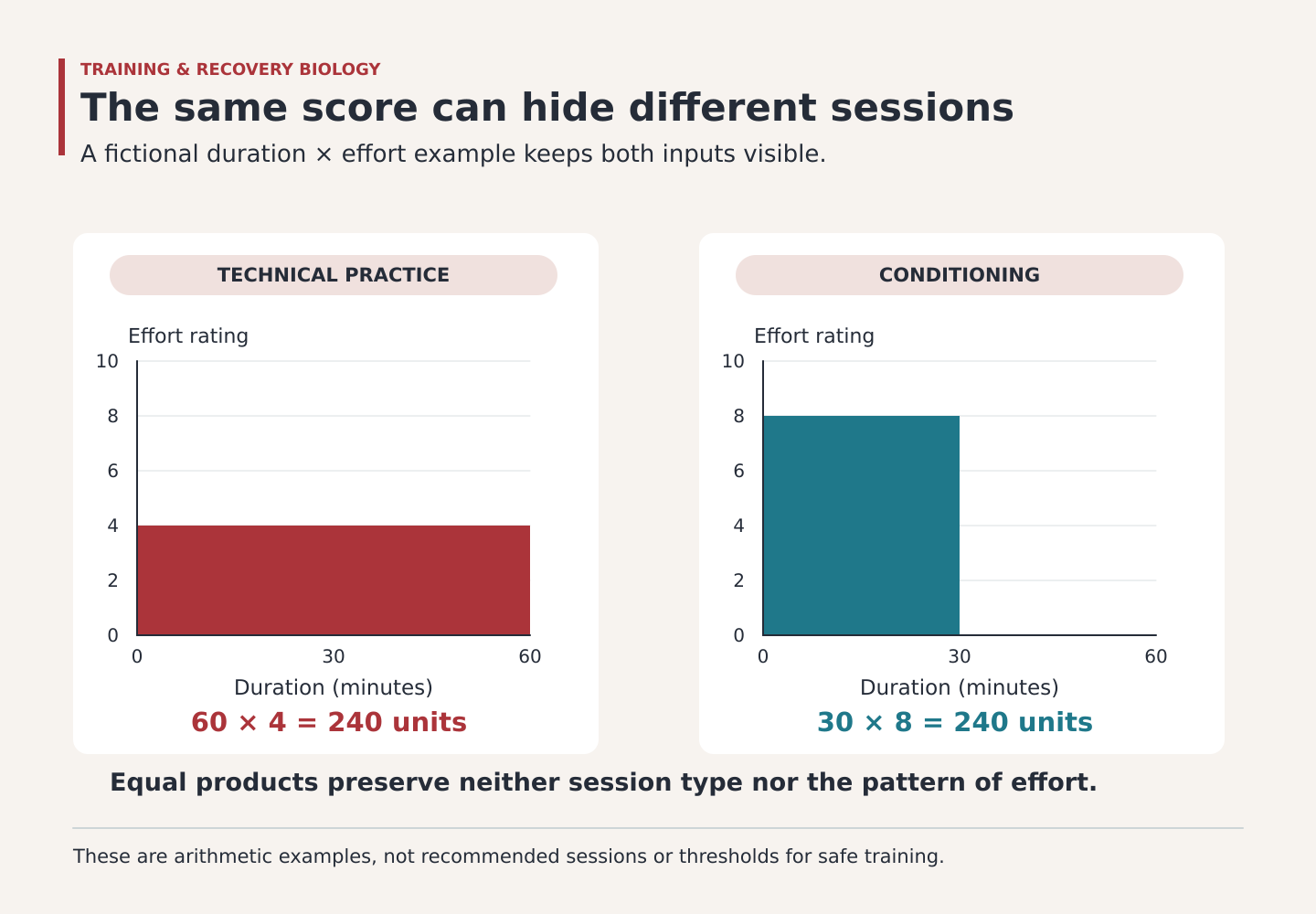
Consider this invented example. The values illustrate a calculation and are not a proposed training plan.
| Entry | Duration | Session rating | Product | Information to retain |
|---|---|---|---|---|
| A: technical practice | 60 minutes | 4 | 240 units | Footwork and controlled skill work |
| B: conditioning | 30 minutes | 8 | 240 units | Different task and effort pattern |
The matching products do not make the sessions physiologically identical. Multiplication deliberately compresses two inputs into one output, so different combinations can produce the same total. Keep the original inputs. A useful spreadsheet shows duration, rating and product in separate columns; it does not replace the first two with the third.
Make recovery notes descriptive
A short next-day note can preserve information that would otherwise be forgotten. Use descriptions you can apply consistently: sleep opportunity, unusual travel, whether work ran late, or a new area of discomfort. Separate an observation from your explanation for it. “Woke three times” is an observation; “the new conditioning session ruined my sleep” is an interpretation requiring more evidence.
There is no need to turn every sensation into a score. One sentence may be more informative than a row of numbers whose definitions change with your mood. If you do use ratings, write down what the endpoints mean. An unexplained “recovery 6” is difficult to interpret even a week later.
Record missing information honestly
A blank effort entry is not zero effort. A missed session is different from a session you completed but forgot to record. Mark these states clearly: not performed, performed but unrecorded, or recorded with an estimated duration. Do not reconstruct a precise rating days later simply to make the spreadsheet look complete.
Similarly, a changed gym schedule should remain visible. Suppose a class becomes longer because the coach adds instruction time. Your recorded duration may increase even if active work does not. A small note about the format prevents an apparent rise in “load” from acquiring a misleading biological explanation.
Review comparable sessions together
Begin a weekly review by grouping like with like. Compare technique sessions with technique sessions, and retain different types as separate rows before calculating any overall total. Ask whether the rating changed for a similar session, whether the session itself changed, or whether the recording convention changed. These are different questions.
An unusual entry is a prompt for context, not proof of overtraining or proof that a recovery product worked. A single better score can reflect a different task, expectation, a calmer day or simple variation. The notebook becomes stronger when it preserves those possibilities instead of explaining every movement with the newest change.
Include a short version note at the top of a digital log. If you change the rating question or the definition of duration, start a new section. This simple habit keeps an apparent training trend from being a change in bookkeeping.
A compact template you can actually maintain
- Date and session type.
- Actual duration and the convention used to count it.
- Round details when they describe the work meaningfully.
- Effort rating using one defined scale.
- Optional duration-times-rating calculation.
- One sentence of context and a separate next-day observation.
Keep the form short enough to complete reliably. The useful outcome is a clear account of your training, not a perfect-looking score. A record that preserves differences between sessions helps you ask better questions about recovery without pretending that a spreadsheet can make clinical or coaching decisions on its own.